Preparing to Buy

Sort out your buying questions before you shop.

Sort through monthly costs, upfront cash, timing, and questions to ask a lender.

Two suburban houses with well-maintained lawns, trees, and bushes under a blue sky with scattered clouds, separated by a driveway with three icons representing security, eco-friendliness, and home.

START WITH YOUR SITUATION

You can prepare before you have every answer

Picture two homes at a similar price. One has higher property taxes, insurance, or association dues; the other leaves more room each month for repairs, savings, and the rest of your plans.

Before you set a shopping target, decide what total housing cost can fit your life—not just what a lender might approve.

Use the readiness snapshot below to record confirmed figures, estimates, and open questions. A missing estimate tells you what to verify before relying on the total.

READINESS SNAPSHOT

Build your homebuying readiness snapshot

A purchase plan can look settled until one estimate changes: monthly costs, upfront cash, timing, income records, or property details. For each area, mark what you know, what you are estimating, and what needs an answer for your situation.

Monthly amount

Record the total monthly housing cost you are comparing and which parts are still estimates. Include costs outside the mortgage payment; the full-cost section below explains the categories.

Cash needed

Cash needs arrive at different points. You may have a down payment in mind but still need to account for closing costs, prepaid expenses, deposits already paid, and money you want to keep available after closing. When you receive a Loan Estimate, review how deposits and credits affect its Cash to Close estimate. Ask the lender to explain anything you did not expect.

Timing

Your timing changes which questions matter now. If you may shop soon, ask a lender how its current preapproval process works and when to begin; review steps and letter periods can differ. If your next purchase depends on selling or keeping your current home, Next Home focuses on coordinating those decisions. If you are already comparing a home or offer, use the Homebuyers Overview milestone map to place your question in the purchase process.

Credit, income, savings, and records

A recent job change, self-employment, or variable income can raise questions about which records a lender may need. Write down what has changed and ask how the lender reviews income and what documentation it wants. If you are buying for the first time, the First-Time Homebuyer page explains the decisions specific to that process.

Property and household details

A condo's association dues, a co-borrower, planned family funds, or second-home use may change which details need review. Note what you already know and what depends on the specific property or arrangement. If you are considering a second property, Second Home covers intended use and added obligations.

Record each open item

For each area, jot down:

  • What I know: Information or costs I can confirm
  • What I’m estimating: Figures I’m using until I can verify them
  • What I need to verify: Questions I still need answered
  • Who can answer it: The person, lender, or source to check with
  • When I’ll revisit it: A useful time to update the estimate

Your Notes app is enough. Keep private financial details out of a general website form; ask our mortgage team how to send documents securely.

A lender’s review can help establish financing options. Your household budget answers a different question: what costs you are willing to carry.


TWO DIFFERENT VIEWS

Separate your budget from loan qualification

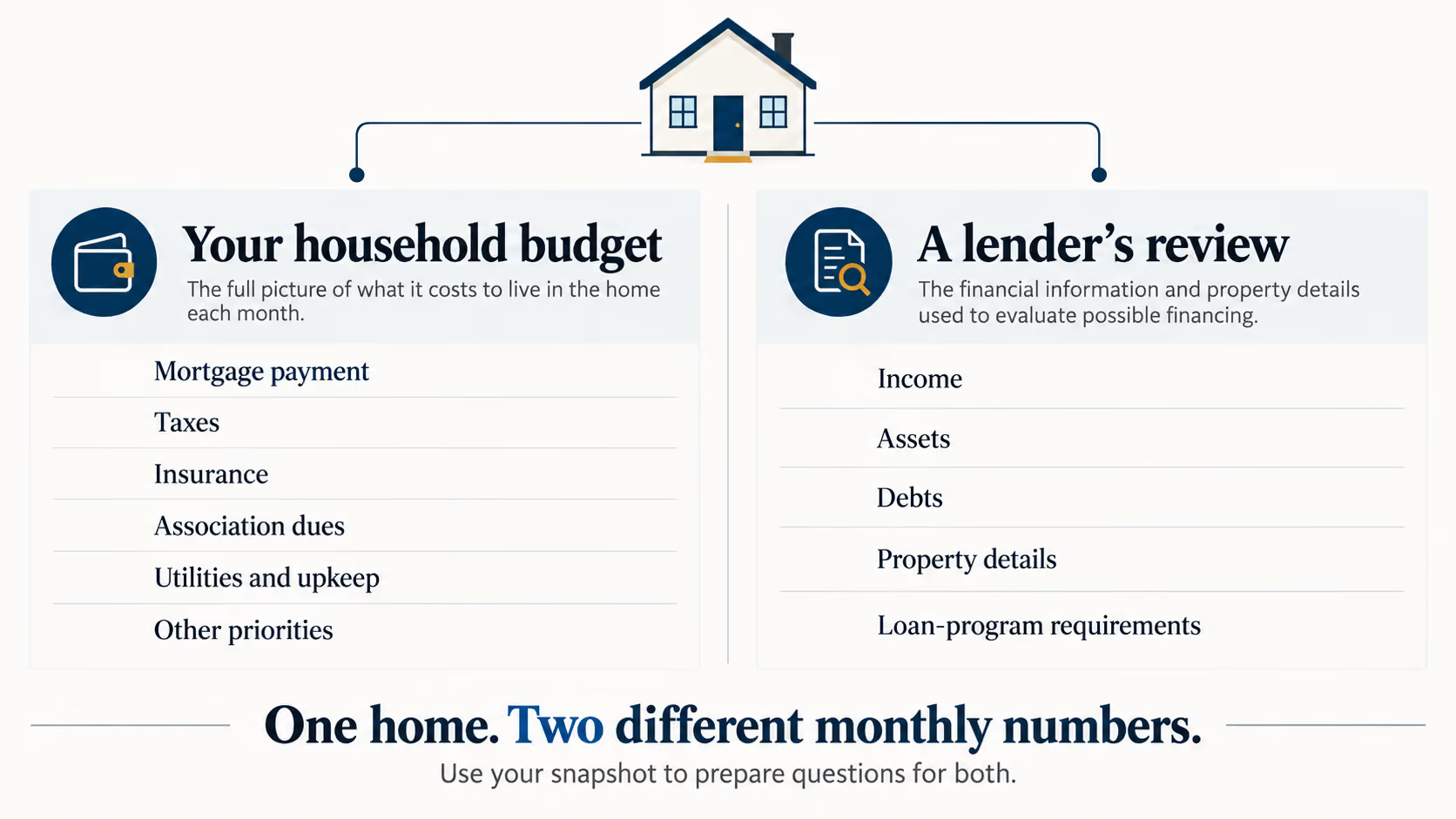
Diagram showing a house linked to two columns: one titled 'Your household budget' listing mortgage payment, taxes, insurance, association dues, utilities and upkeep, other priorities; the other titled 'A lender’s review' listing income, assets, debts, property details, loan-program requirements. Caption reads: One home. Two different monthly numbers. Use your snapshot to prepare questions for both.

Your household budget and a lender’s review answer different questions. One considers how homeownership fits your life; the other evaluates financing under applicable loan requirements.

Your household budget: Account for housing costs alongside everyday expenses, savings, and other priorities. A loan amount a lender may approve does not decide what you want to spend.

The lender’s review: Income, assets, debts, credit, and property information help the lender evaluate the loan being considered. Ask what has been reviewed and what remains subject to confirmation.

Use the Home Affordability Calculator to explore a purchase price using your monthly budget and financing assumptions.

Keep the household total separate from the mortgage payment shown in an estimate. Costs outside that payment still affect what the home will require each month.

BEYOND PRINCIPAL AND INTEREST

See the full cost beyond the loan payment

The mortgage payment is only part of a home’s monthly cost. Property taxes, insurance, association dues, utilities, maintenance, and repairs can change what fits your budget from one home to another.

Depending on the loan and property, the mortgage payment may include principal and interest, property taxes, homeowners insurance, and mortgage insurance. Taxes and insurance may be collected through an escrow account or paid separately. Association dues are usually separate. Utilities, maintenance, and repairs are outside the mortgage payment, but still belong in your monthly housing budget.

When you compare homes or estimates, ask:

  • Mortgage payment: Which costs are included in the mortgage payment?
  • Separate bills: Which costs will I pay separately, and how often?
  • Estimate basis: Are the tax, insurance, or association figures based on this property, or are they estimates?
  • Other monthly costs: What regular costs outside the mortgage payment should I include in my budget?

The CFPB’s homebuying budget guide explains how to account for the total monthly home payment, utilities, maintenance, repairs, and other priorities.

Use the Mortgage Payment Calculator to compare monthly estimates as the price, down payment, or recurring costs change.

Once you have a clearer monthly range, there’s another number to plan for: the cash you may need before and at closing.

COSTS BEFORE AND AT CLOSING

The down payment is only one part of cash to close

Monthly costs describe what you may pay over time. Cash to close is an estimate of the funds due at closing. Some purchase costs may come due earlier.

Cash to close may include a down payment, closing costs, and prepaid expenses. Deposits already paid and credits may affect the estimate. The exact amounts and timing depend on the transaction.

Use the Cash-to-Close Calculator to estimate what remains to bring to closing after accounting for costs, deposits, and usable credits.

Separately, plan for moving, initial repairs, and money you want to keep available after closing. Those needs belong in your purchase budget even when they are not part of the cash-to-close figure.

When you review the estimate, ask:

  • What’s included? Which costs make up the cash-to-close estimate?
  • What’s already counted? How are deposits and credits reflected?
  • What could change? Which amounts are still estimates, and when might they be updated?
  • What’s due earlier? Which deposits, inspection, appraisal, or other purchase costs may be due before closing, and how will amounts already paid be reflected?

The CFPB’s guide to mortgage costs describes common upfront costs. Its Loan Estimate explainer shows where to find and how to review the estimated cash to close.

Once you’ve separated the costs and timing, the next question is when to bring those estimates to a lender.

WHEN TO TALK WITH A LENDER

Understand mortgage preapproval before you shop

You do not need every cost settled before asking how the lender’s process works. The questions that are most useful depend on whether you are exploring, getting ready to shop, or comparing a home or offer.

If you are still exploring

Ask what an initial conversation involves and what you can discuss before applying. You do not need to send financial records through a general contact form just to ask about the process.

If you are getting ready to shop

Ask how the lender’s current preapproval process works, what information it reviews, how your information is handled, and how long a letter remains current. A preapproval is tentative and based on assumptions; it is not a guaranteed loan offer or final loan decision. Lenders may use “prequalification” and “preapproval” differently, so ask what the term means in that lender’s process. Read what a preapproval letter means.

Ready to begin the pre-approval or application process? Register in our secure portal. After you register, you can continue the loan process, securely submit documents, and communicate with your loan officer.

If you are already comparing a home or offer

Use the Homebuyers Overview milestone map to see how the shared purchase stages connect. If you receive Loan Estimates, the CFPB comparison guide explains what to compare.

Once you know what the lender may review, you can prepare for the document conversation—and learn how to share information securely.

DOCUMENTS AND PRIVACY

Know what to gather and how to send it securely

When you are ready to discuss a loan, ask what information the lender needs and how to provide it securely. Requirements depend on the loan and your circumstances; lenders may ask about income, employment, assets, debts, and the property.

Use these examples to ask which records apply and how to share them:

  • Income and employment: Ask whether pay stubs, W-2s, tax returns or business records apply to your situation and which periods the lender needs.
  • Assets and purchase funds: Ask which bank or investment statements are needed and how to document gift funds or other money you plan to use.
  • Debts and obligations: Ask which current loans, housing payments or other obligations need to be documented.
  • Secure delivery: Where should I send the requested records, and how will I know I am using the correct channel?

Some circumstances can change which questions or records matter most. Here are a few details worth raising early.

DETAILS TO RAISE EARLY

Flag details that could change what needs review

If your income, funds, household, or property plans include any of these details, raise them with the lender. What they mean depends on the specific loan and property; asking does not establish eligibility or predict an outcome.

  • Self-employment or variable income: Mention how your income is earned and ask what the lender may need to understand about it.
  • Recent employment or income changes: Explain what changed and ask whether it affects what the lender will review.
  • Family funds or a co-borrower: Describe the planned arrangement and ask what responsibilities or questions may apply.
  • Condo or association dues: Include the property type and recurring costs when discussing estimates.
  • Down-payment or closing-cost assistance: Ask whether current programs may be relevant to your location and circumstances. Availability and requirements vary; verify details with the program administrator or another authoritative source.

For examples of records a lender may request—and a reminder that requirements vary—see the CFPB’s guide to gathering mortgage paperwork.

Once you’ve identified the details that matter to your situation, you can choose the question to resolve first.

Preapproval questions

Does a preapproval mean my mortgage is approved?

No. A preapproval is based on assumptions and remains subject to confirmation. Ask the lender what it reviewed and what would still need to happen. The CFPB explains preapproval letters and their limits.

Should I plan to spend the full amount in a preapproval letter?

No. The letter does not determine what monthly or upfront costs fit your household budget. Set your own limits.

How far ahead should I request preapproval?

There’s no universal timeline. Letters may expire, and lender processes differ. Ask when to request one based on your plans and how long it will remain current.

YOUR PLAN

Choose a next step that fits where you are

Share whether you are exploring, getting ready to shop, or considering a specific home. Name the estimate or process question you want to discuss so the conversation has a useful starting point.