Mortgage Review

Review your current mortgage.

Understand your current mortgage, investigate a change, and decide what deserves attention.

A mother with long blonde hair sitting on a couch, holding a phone to her ear and smiling while her young daughter in a pink outfit sits beside her holding a bowl and watching a laptop in front of them.

REVIEW TRIGGER

What prompted you to review?

Start with the question you need answered before considering a mortgage change.

A mortgage review means checking your existing loan, housing costs, and plans to understand what needs attention. Working through this page does not start an application or require you to change your loan.

A changed payment, a new notice, a home or household change, or a future plan may bring up questions such as:

  • Why did the amount due change?
  • What does this escrow, tax, insurance, or mortgage-insurance notice mean?
  • Does this loan fit a planned change or how long I expect to keep the home?

Write down your question and any relevant date. Does it concern the loan itself, the payment breakdown, or a cost you pay separately?

CURRENT MORTGAGE

Understand your current mortgage and payment

Your statement breaks down the payment; your loan documents explain the terms.

Current loan terms

Record your current balance, interest rate, required principal-and-interest payment, and remaining term. Check the loan type, whether the rate can change, any next rate or payment-change date, and features that affect when principal or interest is due.

If a term is unclear, ask your loan servicer—the company that manages your mortgage account—which document explains it.

What makes up the payment?

Separate the loan payment, amounts collected with it, and costs you pay separately:

  • Loan payment: Principal is the amount borrowed; interest is the cost of borrowing.
  • Amounts collected with it: Your payment may include property taxes and homeowners insurance through escrow, plus mortgage insurance if it applies.
  • Separate housing costs: Homeowners association (HOA) dues, utilities, maintenance, and repairs add to the cost of owning the home.

If taxes or insurance are paid through escrow, your servicer collects money toward those bills and pays them when due. If they are not escrowed, you pay the relevant authority or insurer directly. The CFPB’s explanation of principal, interest, and total monthly payment shows how these amounts fit together.

For a future plan, keep these terms and costs as your starting point. If your payment changed, which part of that picture moved?

PAYMENT CHANGES

Why did my mortgage payment change?

Start with the changed line and the record behind it.

Escrow and property taxes

An annual escrow analysis compares expected tax and insurance bills with the account balance. Compare yours with the latest bills or notices.

A fixed interest rate does not keep property taxes or insurance premiums fixed. Changes in those costs can change the total payment when they are collected through escrow.

A shortage means the escrow balance is below its required target. Your new payment may include both an amount to address that shortfall and more money for expected future bills.

Paying the shortage does not necessarily return the payment to its old amount. Ask the servicer to identify each part in your analysis.

The servicer can explain its calculation; the taxing authority can explain the bill or assessment. If a bill appears unpaid or a figure is unfamiliar, contact the servicer and keep both records together while you ask for an explanation.

The CFPB’s overview of escrow accounts explains what escrow may cover and why the amount can change. If you are unsure how an escrow change was calculated, review the CFPB’s steps for escrow questions.

Homeowners insurance

Compare the renewal notice with your prior premium and the escrow analysis. Check coverage limits and the deductible along with price; a lower premium can reflect a coverage change.

Ask your insurer or insurance professional about the policy and premium. If insurance is paid through escrow, your servicer can explain when the bill was included in the payment calculation.

Mortgage insurance

Mortgage insurance is tied to the loan; homeowners insurance covers the property under an insurance policy.

If a mortgage-insurance charge appears on your statement, ask the servicer what type applies and what terms govern cancellation. Private mortgage insurance (PMI) applies to certain conventional loans. FHA mortgage insurance has different rules; VA-backed loans do not require monthly mortgage insurance. Check the CFPB’s PMI guidance for its scope, then confirm your loan’s terms with the servicer.

Loan terms or servicing

Changed principal and interest: Compare the line with your promissory note (the loan agreement) and any rate or payment-change notice. For an adjustable-rate loan, check the rate-change notice. If a temporary payment reduction is ending, review the agreement or notice that explains when the payment changes.

New fee or missing payment: Compare the transaction history and ask the servicer to trace the item. The CFPB lists common reasons payments change and what to check.

Once you find the relevant record, the remaining question becomes more specific. Do you need an explanation, a comparison, or a correction?

MORTGAGE REVIEW DIAGNOSTIC

Work through the Mortgage Review Diagnostic

Work out what you know, what is missing, and who can help.

For example: If you plan to renovate next year, record the estimated cost and timing, your current loan terms, and what repayment your budget could support. The question to resolve is how to fund the work while accounting for your existing mortgage and other costs—not which loan to choose first.

  1. Record the reason for review. Note the date and source of a notice. If a payment changed, write down the prior and new amounts and the line that moved. If a home or household change prompted the review, note the decision and timing you are weighing.
  2. Identify the part involved. For a payment question, pinpoint principal and interest, escrow, taxes, insurance, fees, or payment activity. For a future plan, identify the loan term or housing cost that could affect it.
  3. Compare the right information. For a changed amount, compare current and prior statements with the related notice, bill, loan document, or payment history. For a future plan, review the relevant loan terms and current costs; keep known facts separate from estimates.
  4. Ask the right source. Ask the servicer about a payment or account record, the tax authority about an assessment or bill, and the insurer about coverage or premium. The Mortgage Link team can explain mortgage concepts and tradeoffs; other professionals should address tax, insurance, legal, or financial-planning questions.
  5. Write down the outcome. Record the explanation you found or the specific question still open, who can address it, and your next action and relevant date. Review the findings with anyone who shares the decision, keeping the supporting records together.

RESOURCE DOWNLOAD

Current Mortgage Review Guide

Use the printable guide to keep your mortgage details, findings, and questions in one place.

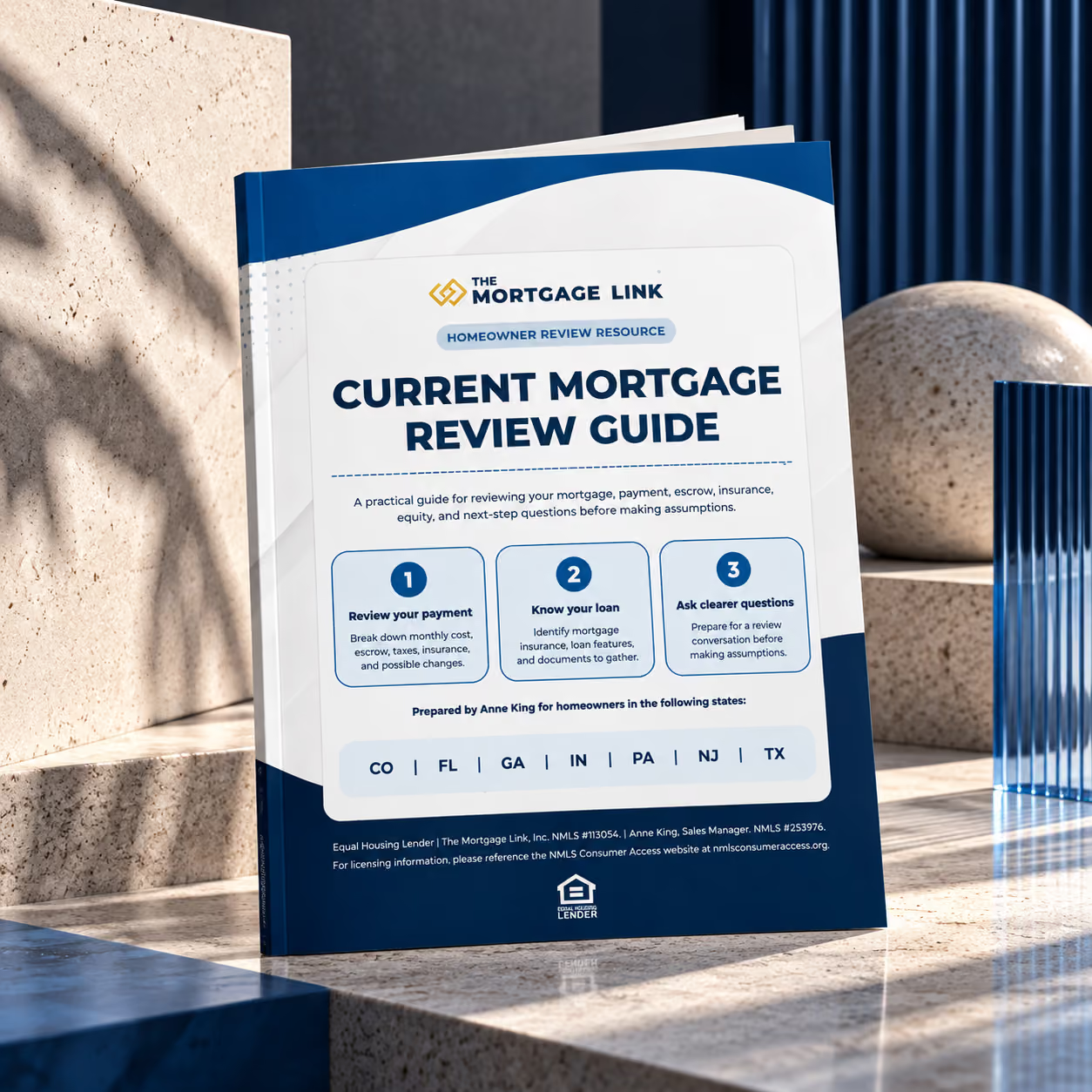
A booklet titled 'Current Mortgage Review Guide' from The Mortgage Link, described as a practical guide for reviewing mortgage, payment, escrow, insurance, equity, and next-step questions, prepared for homeowners in CO, FL, GA, IN, PA, NJ, TX.

RELEVANT NEXT STEP

Choose a next step based on what you learned

Use your findings to choose who to contact or what to explore.

  • Account or payment question: Contact the servicer listed on your mortgage statement. It can explain your account, payment history, or escrow calculation.
  • Still unresolved: If you believe a payment or account record is wrong, review the CFPB’s steps for disputing an error or requesting information. Your servicer may use a special address for written requests that differs from its payment address. Keep copies of what you send and receive.
  • Tax bill or insurance policy: Contact the taxing authority or insurance professional responsible for that information. Your mortgage servicer does not set a property-tax assessment or insurance coverage.
  • Worried about making a payment: Contact your servicer promptly and reach out to a HUD-approved housing counseling agency for free, expert help understanding options and working with the servicer.
  • Keeping your current loan: Ask your servicer whether PMI cancellation or a mortgage recast applies to your loan. A recast recalculates the principal-and-interest payment after a principal reduction, using the existing rate and remaining term. Ask about eligibility, fees, and requirements before committing cash.
  • Replacing your mortgage: Continue to Refinance to weigh your goal, total costs, timing, and tradeoffs before deciding whether a new loan fits.
  • Borrowing against equity: See Home Equity for questions about the planned use, amount, repayment, and longer-term housing implications.
  • Reverse-mortgage question: See Reverse Mortgage for its structure, ongoing responsibilities, and counseling considerations. Include a trusted supporter if helpful.
  • Question answered: You may decide that no mortgage change is needed. Keep the records that helped answer it and revisit the question if your circumstances or loan terms change.

Use the Refinance Savings Calculator for a fixed-rate comparison without cash-out, including principal and interest, fees, and remaining balances.

For a broader view of homeowner paths, return to the Homeowners Overview. If you are already working with The Mortgage Link and need help with a mortgage in progress, contact our team.

Keep private information secure. Use the secure channel provided for account details or documents. Keep account numbers, statements, login details, and other private financial information out of the public contact form.

Ready to apply or request a preapproval? Create your secure portal account to begin your application and share documents.